You are in a leadership meeting. The sustainability team has just added “Digital Product Passport” to the risk register. Your legal counsel talks about Regulation (EU) 2024/1781 and delegated acts. Your supply chain team worries about data gaps. Then your CFO asks a very simple question:
“How much is this going to cost us, and what do we get back for it”
By default, the Digital Product Passport (DPP) is a compliance cost. New data pipelines, new labels on every product, new internal processes. But if you are a product or marketing leader, you also know something else: Any new mandatory touchpoint that sits on the product and in your customers hands can become a commercially viable channel.

That is where the Layerise Customer Data Experience Platform (CDXP) comes in. DPP gives you a new regulatory obligation. Layerise helps you turn it into first party data, engagement, loyalty, and incremental revenue. This guide walks through what the DPP really is, why it matters, and how to prepare in a way that does not just tick the compliance box, but supports a profitable customer strategy.
From climate ambition to your product roadmap
The DPP is one of the concrete tools created under the Ecodesign for Sustainable Products Regulation (ESPR), Regulation (EU) 2024/1781. This regulation is the practical arm of the European Green Deal to make sustainable products the norm in the European market and support climate neutrality by 2050.
Instead of targeting only energy related products, ESPR gives the European Commission a framework to set detailed requirements on durability, repairability, recycled content, and information disclosure for a long list of product groups. For many of these, having a Digital Product Passport will not be optional. It will be the ticket to enter the market.
Seen from the board room, that means a few things:
DPP is not a pilot or a voluntary scheme. It is law.
DPP work will sit in your investment budget and operating budget.
Someone in your organisation will own it and be accountable for it.
If you stop there, DPP sits as a cost line. But if you design your approach on top of a CDXP that already powers product registration, digital user journeys, and loyalty, that same investment starts to pay back through data, retention, and new service revenue.

The passport as a living story of each product
The simplest way to think about the Digital Product Passport is as a living digital record that travels with each product from production to end of life. It links together information that today lives in disconnected places:
Materials and components
Compliance and test reports
Manufacturing locations and operators
Usage and maintenance instructions
Repair and refurbishment history
End of life and recycling guidance
In practice, this record is accessed by scanning a data carrier on the product or its packaging, usually a QR code. The scan resolves to structured data that can be read both by machines and by people, from customs officials to repair shops to your end customers.
For the circular economy this is a game changer. Better data means better decisions about repair, reuse, and recycling. For you as a brand, it is also a persistent digital touchpoint anchored to each physical product.
Layerise already treats the product as a digital experience, not just an object. When a customer scans a QR code to register, access support, or claim warranty, they land in a rich customer first optimized journey with educational content, chat, and support. The DPP slot becomes one more layer in that experience, not a separate technical project that lives on its own.
There is a serious standards machine behind DPP
From a distance, DPP can look like yet another "vague" European initiative. Up close, it is anything but vague.
The European standardisation bodies CEN, CENELEC, and ETSI have been tasked to deliver a structured framework for the DPP system. A dedicated joint committee, CEN CELEC JTC 24, is coordinating this work, with European standards expected to be ready around March 2026.
For product and technology teams this matters for two reasons:
DPP is designed to be built on harmonised standards, not on one off vendor formats.
The timelines are ambitious but clear enough that you can work backwards from them.
We are not watching this from the sidelines. We are actively involved in the European CIRPASS-2 and a contributor to CENELEC JTC 24 project and in national standards work on Digital Product Passports, helping translate regulatory intentions into workable data and experience models for brands.
The eight technical building blocks you will hear about
JTC 24 describes the DPP system through eight technical standards. They sound abstract, but they map closely to decisions you already need to make.

Here is what they mean in everyday language:
Unique identifiers (EN 18219:2026): Each product, economic operator, and facility needs an identifier that is globally unique and persistent. Think GTIN, serial number, and unique company IDs that can be resolved by others.
Data carriers (EN 18220:2026): The bridge between the physical product and its digital record. In most mass consumer scenarios this will be a QR code that your customers can scan with a regular smartphone.
Access rights management, information system security, and business confidentiality (EN 18239:2026): Not everyone should see everything. Standards define how to protect sensitive data while still giving regulators, partners, and consumers what they need.
System interoperability (EN 18223:2026): Your DPP solution needs to work with multiple systems and sectors. That means shared semantics and technical formats so that a recycler or a marketplace can understand your data without custom mapping.
Data exchange protocols (EN 18216:2026): Rules for how DPP data is formatted, transmitted, and updated. This affects how you integrate PLM, ERP, PIM, and CDXP systems with your passport service.
Data storage, archiving, and data persistence (EN 18221:2026): Requirements for keeping data available and trustworthy over long product lifecycles, including backups and migration.
Data authentication, reliability and integrity (EN 18246:202): Mechanisms that ensure the data has not been tampered with and can be trusted for regulatory and commercial decisions.
APIs for product passport lifecycle management and searchability (EN 18222:2026): Interfaces that allow other systems to search, retrieve, and update DPP information where authorised.
On their own, these eight areas can feel like a long technical checklist and therefore like pure cost. Seen together, they form a blueprint for how product data should move through its entire life cycle: how you identify each product uniquely, how you connect a data carrier to it, who may see which parts of the information, how systems exchange and store it over many years, how you protect integrity and authenticity, and how other applications can plug in through standard interfaces. When you treat the eight areas as a coherent architecture rather than separate obligations, you are far more likely to design a DPP setup that is robust, scalable, and ready to support both regulatory needs and new circular business models.
Central registry, local reality
A common concern we hear when speaking with brands is this:
“Will all our product data now sit in a single European database where anyone can see it”
The answer is more nuanced. ESPR requires that DPP data be stored by the economic operator responsible for creating it, or by certified DPP service providers acting on their behalf. At the same time, a central DPP registry managed by the Commission will index unique identifiers and connect them to the relevant passports, with further details to be specified in delegated acts and sector rules.
In plain terms:
You remain responsible for hosting and maintaining most of your product specific DPP data.
The central registry gives authorities and other stakeholders a way to discover and validate passports.
This decentralised architecture protects business sensitive details while still enabling regulatory enforcement and cross border trade. For you, it also means you need a reliable, scalable environment that can expose DPP data securely and consistently over many years. That is a natural fit for a CDXP that already stores structured product content, customer interactions, and experience logic, and that offers mature APIs and integrations.
What goes inside the passport
The exact data you must provide will depend on the product group and the delegated acts that apply. But several core categories are already clear from ESPR and related guidance. You should expect to cover at least:
Product identity: Identifiers such as unique identifiers, model name, serial or batch number if relevant, and commodity or customs code.
Compliance and safety: Declarations of conformity, applicable directives and regulations, test reports, certificates, information on substances of concern.
Economic operators and supply chain: Manufacturer and importer identifiers, production site information, and in some cases data on critical raw materials or due diligence.
Usage and maintenance: Digital instructions, recommended maintenance schedules, repair information, spare parts, and care guidance that extend the useful life of the product.
End of life: Disassembly and recycling instructions, material composition, and information needed by recyclers and re manufacturers to close the loop.
Now imagine these data points flowing into a static portal that no customer ever sees. That is pure cost. With Layerise, the same content powers:
Rich digital manuals and post sale journeys.
In context service prompts based on product registration and behaviour.
Proactive maintenance reminders and campaigns.
Warranty claims that are connected to both the customer and the product history.
You have to prepare this information anyway. The strategic question is whether you keep it in a compliance silo, or align it with your product strategy so it actively drives loyalty and revenue.

Different roles, different views
One of the strengths of the DPP concept is that it does not assume a single audience. It recognises that stakeholders need different level of access and rights as:
Consumers need clear, accessible information without login, app downloads, or paywalls.
Repairers need technical detail.
Recyclers need material and disassembly data.
Market surveillance and customs authorities need identifiers and compliance evidence.
This is often referred to as the need to know principle. People see what they are entitled to see, nothing more. From an experience perspective, this is where Layerise shines. For each scan of your data carrier, you can present different pieces of information:
A customer friendly view with storytelling, onboarding, sustainability highlights, and support options.
A professional view with deeper technical information behind an authenticated gateway.
An internal view for your own teams that connects DPP data with CRM and service history.
The underlying passport can be the same, but the journey is adapted to who is in front of the screen.
Who needs to move first
The DPP will not arrive for all products at the same time. The first ESPR work plan for 2025 to 2030 focuses on sectors with high environmental impact and strategic relevance. Sources and early drafts point to priority groups such as:
Final products: Textiles and apparel, furniture and mattresses, tyres, and other high impact consumer goods.
Intermediate products and materials: Iron and steel, aluminium, and related materials that feed multiple supply chains.
In parallel, other regulations, including the EU Battery Regulation, revised rules for toys, detergents, and other sector specific laws, are also introducing DPP style obligations, often with their own timelines and registries.
If your categories sit inside this first wave, you do not really have the option to wait and see. But even if they do not, you can safely assume that DPP style transparency will reach you in the coming years. ESPR is explicitly designed to be updated with new product groups over time.

Turning a cost centre into a commercial growth engine
Let us come back to the CFO question from the meeting at the start. On one side, you have unavoidable costs:
Mapping data and cleaning it.
Integrating systems and standing up infrastructure.
Adding QR codes or other data carriers to packaging and products.
Training internal teams and partners.
On the other side, you have choices about where you place this investment. If you place it in a narrow compliance tool, you get compliance and not much else. If you place it in a CDXP that unifies customer data, brand safe AI, post sale experiences, and DPP in a single platform, you turn that same investment into something entirely different.
With Layerise, a DPP ready setup looks like this:
Every scan becomes an owned relationship: The DPP QR does not point to a dead technical portal. It lands the customer in an interactive Layerise experience in their language, where they can register, give consent, receive tailored content, and join your loyalty club.
Product data and customer data live together: All the effort you spend structuring DPP data now strengthens your customer profiles. You know not only who your customer is, but exactly which product version they own, where it came from, and how they use it.
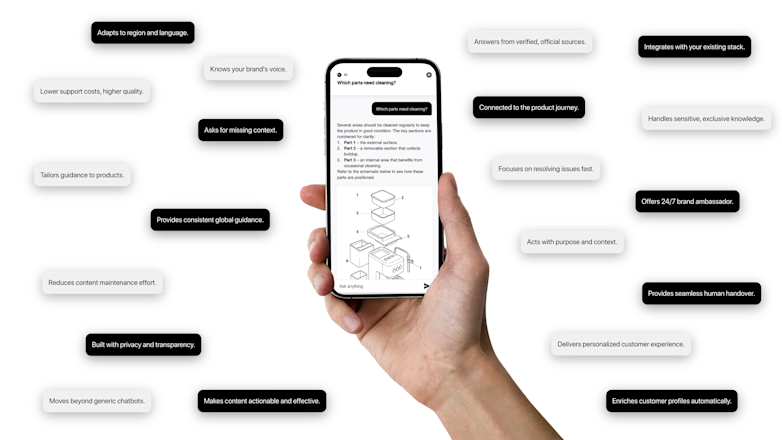
Brand Safe AI makes DPP content usable: Instead of sending customers into complex PDF instructions or regulatory tables, you let them ask natural questions and get instant answers grounded in your verified DPP and support content. The same assistant supports your service teams.
Compliance workflows become automation journeys: Information that you must collect or expose for regulatory reasons also feeds proactive notifications, replenishment prompts, and refurbishment programs. You comply and you drive revenue, using the same dataset.
You have one platform for registration, warranty, support, and DPP: No need for separate stacks and overlapping costs. Product Registration, Warranty Manager, Digital User Manuals, and Digital Product Passport all share the same foundation and analytics.
In other words, DPP remains a compliance obligation, but in your profit and loss it is supported by commercially viable solutions.
The takeaway for product leaders
The Digital Product Passport is not a distant topic for sustainability reports or technical committees. It will reshape how your products are documented, sold, serviced, and recycled in the European market. You cannot avoid the cost side. You can decide whether those costs sit in a narrow compliance project or in a platform that also grows your business.
Layerise is already working inside European standardisation projects, partnering with brands on QR driven journeys, and operating one of the first CDXP solutions that brings together customer data, post sale experiences, brand safe AI, and DPP in one suite.
Learn how to collect valuable insights on your customers to sell even more.

A trusted, brand-safe AI assistant that knows your products, your customers and your content.
We’re excited to announce that Layerise will be speaking at the upcoming LOOP Forum event